
What Makes a Modern Facelift Surgery Different?
Expert Insights from Dr Adel Quttainah a Plastic Surgeon
Not a dramatic change, just a natural rejuvenation
When people hear facelift, they imagine an overly tight or noticeably altered result. Today, facial rejuvenation has come a long way. Modern facelift surgery is no longer about simply pulling the skin tighter, it is about restoring youthful facial contours while preserving your natural features.
“What makes a modern facelift different, and why does it look so much better than what my mother’s generation had done?” The answer is simple: Modern facelift technique restore structure rather than stretching skin.
Dr Adel Quttainah, a double board-certified plastic and reconstructive surgeon with over two decades of experience across Kuwait, Dubai and Qatar, specialises in modern facelift surgery built on the precise principles outlined above.
This guide walks through exactly what separates a modern facelift procedure from the outdated version, what results you can realistically expect, and how the right surgical approach makes all the difference.
What is a Modern Facelift?
A modern facelift is not simply an updated version of the traditional procedure; it works on an entirely different layer of the face.
Rather than pulling the skin tight and trimming the excess, a modern facelift technique repositions the deeper muscular and connective tissue layer beneath the skin, often referred to as the SMAS (superficial musculoaponeurotic system) or, in more advanced cases, the deep plane.
Facial ageing involves more than loose skin
Facial ageing affects much more than the skin. Over time, the cheeks descend, facial volume decreases, supporting tissues weaken, skin loses elasticity, and the underlying bone structure gradually changes. Together, these changes contribute to sagging, jowls, and a less defined facial contour.
That is why modern facelift surgery goes beyond simply tightening the skin. By addressing the deeper structures of the face, it restores support and creates more natural, balanced, and longer-lasting results.
Traditional Facelifts vs the Latest Facelift Techniques
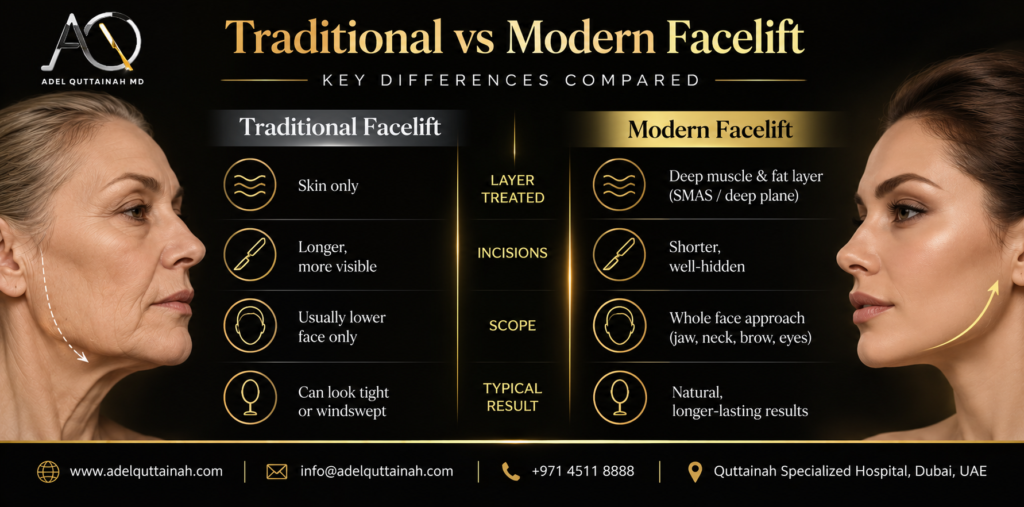
|
Aspect |
Traditional Facelift |
Latest Facelift Techniques |
|---|---|---|
|
Layer treated |
Skin only |
Deeper muscle and fat layer (modern facelift technique), allowing skin to be redraped with little to no tension |
|
Typical result |
Can look tight, flattened or “wind-swept”; tends to relapse faster since skin alone has limited structural strength |
More natural, longer-lasting contour |
|
Incisions |
Often longer and more visible |
Shorter, carefully hidden within the hairline and natural ear creases |
|
Scope |
Treats one area (usually the lower face) in isolation |
Considers the whole face as one connected system — jawline, neck, brow and eyes together |
What makes a modern facelift different?
Three things, in particular, set today’s approach apart:
|
Deep plane repositioning, not skin tightening: the muscle and fat are lifted as a single unit, so the face is restored to an earlier position rather than simply stretched. |
Smaller, better-concealed incisions: placed carefully so scarring fades within the hairline and natural creases. |
Facial harmony over isolated fixes: this approach looks at how the jaw, neck, brow and eyes relate to one another, rather than tightening one area while ignoring the rest. |
Latest Facelift techniques: What is the Latest Facelift Technique?
The latest facelift techniques focus on restoring deeper facial structures rather than simply tightening the skin. The right technique depends on your facial anatomy, degree of ageing, and aesthetic goals.
|
Deep Plane Facelift |
SMAS Facelift |
|
Vertical Lift Techniques |
Combination Facial Rejuvenation |
Modern Facelift results: What patients can really expect
Recovery from modern facelift surgery usually involves temporary swelling and bruising, with results continuing to improve over the following weeks and refine over several months.
Modern facelift results typically include:
- A smoother jawline
- Reduced jowls
- Better neck definition
- Lifted cheeks
- Softer facial folds
- A refreshed, more youthful appearance
The best modern facelift results enhance your natural features, leaving you looking refreshed rather than looking like you’ve had surgery.
Who is a good candidate for a modern facelift procedure?
You may be a suitable candidate for a modern facelift procedure if you have:
- Moderate to significant facial sagging
- Jowls affecting jawline definition
- Loose skin around the neck
- Deepening facial folds
- Good overall physical health
- Realistic expectations about surgery
Some people choose surgery in their 40s to address early signs of ageing, while others seek treatment in their 60s or beyond. The decision is highly individual and should always be based on a thorough consultation with an experienced plastic surgeon.
What are the benefits of a modern facelift?
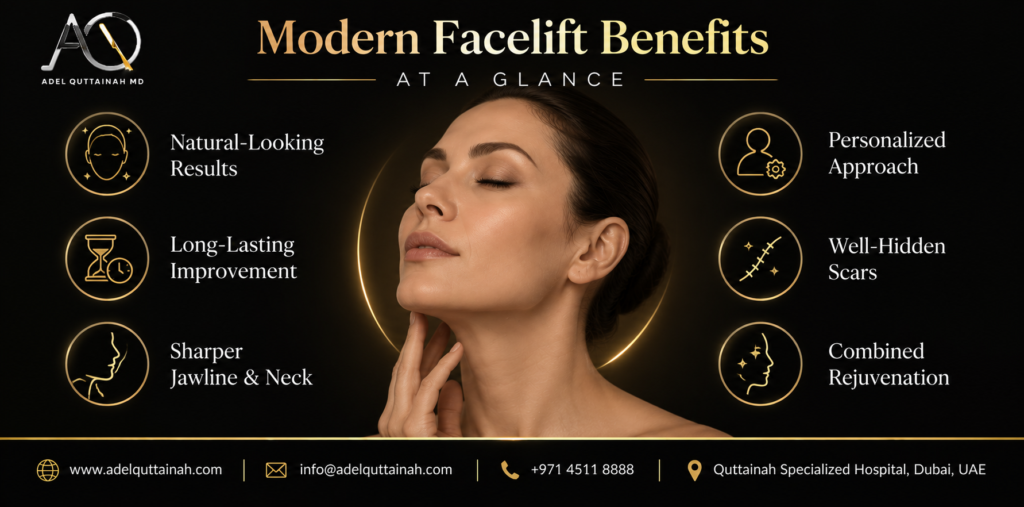
|
Benefit |
How It Helps |
|
Natural-looking results |
Restores youthful contours without looking overdone. |
|
Long-lasting improvement |
Repositions deeper facial tissues for durable results. |
|
Sharper jawline and neck |
Reduces jowls and improves facial definition. |
|
Personalized approach |
Tailored to your anatomy and aesthetic goals. |
|
Well-hidden scars |
Incisions are placed around the ears and hairline. |
|
Combined rejuvenation |
Can be performed with a neck lift, eyelid surgery, or fat grafting. |
|
Greater confidence |
Helps you look refreshed while maintaining your natural identity. |
Why choose Dr Adel Quttainah for Modern Facelift Surgery?
Achieving excellent modern facelift results depends on the surgeon’s expertise as much as the technique itself. Dr Adel Quttainah is known for delivering natural-looking facial rejuvenation through a personalized, patient-focused approach.
Why Dr Adel Quttainah’s surgical precision makes the difference in modern facelift surgery
|
Double Board-Certified Expertise – Internationally trained plastic and reconstructive surgeon with advanced surgical credentials. |
Microsurgical Precision – Applies meticulous reconstructive expertise to achieve refined, natural-looking facial rejuvenation. |
|
Regional Experience – Trusted by patients across Kuwait, Dubai, and Qatar with over two decades of surgical experience. |
Natural Facial Harmony – Focuses on restoring youthful balance while preserving each patient’s unique features. |
Refresh your look with modern facelift surgery
Choosing the right technique and surgeon is the single biggest factor in achieving a natural-looking result. Dr Adel Quttainah brings a rare combination of reconstructive microsurgical precision and aesthetic artistry to every facelift he performs.
Book a consultation with Dr Adel Quttainah today to discuss what a modern facelift could look like for you.
FAQs
What is a modern facelift?
A modern facelift is an advanced facial rejuvenation procedure that lifts and repositions the deeper tissues of the face rather than simply tightening the skin. The aim is to create natural-looking, long-lasting results while maintaining your individual facial expressions and features.
What is the newest facelift technique?
There is no single technique that is considered the newest or best for every patient. Among the latest facelift techniques, deep plane facelift and advanced SMAS-based procedures are widely recognised for their ability to produce natural-looking outcomes by addressing deeper facial structures.
Which facelift looks the most natural?
The most natural-looking facelift is one that restores facial support without creating excessive tension on the skin. Modern techniques that reposition deeper tissues and are customised to the patient’s anatomy generally provide the most subtle and balanced results.
Is a deep plane facelift better?
A deep plane facelift can be an excellent option for some patients, particularly those with more significant facial sagging. However, the most appropriate procedure depends on your facial anatomy, degree of ageing, and desired outcome. A consultation with an experienced plastic surgeon is the best way to determine the right approach.
Is the SMAS facelift outdated?
No. The SMAS facelift remains one of the most established and effective facelift techniques. While surgical methods continue to evolve, SMAS-based procedures are still widely used because they provide reliable, natural-looking rejuvenation for many patients.
How long does a facelift last?
Although the ageing process continues, facelift results are generally long-lasting. Many patients enjoy their results for around 10 to 15 years, depending on factors such as skin quality, lifestyle, genetics, and the surgical technique used.
Does a facelift look natural?
When performed using modern surgical principles by an experienced plastic surgeon, a facelift should look natural. The goal is to help you appear refreshed and youthful without making your face look tight or altering your unique features.
At what age is a facelift best?
There is no best age for facelift; most people consider a facelift between their 40s and 60s. The suitability depends on the degree of facial ageing, skin elasticity, and overall health.
Can a facelift be combined with a neck lift?
Yes, a facelift can be combined with a neck lift for patients who have concerns such as muscle laxity, loose skin, or excess fat beneath the chin.
What are the risks of facelift surgery?
All surgeries carry some amount of risk, facelift surgery is generally safe when performed by a skilled surgeon following all the post-operative instructions. However, the potential risks include infection, bleeding, swelling, bruising, delayed healing, changes in skin sensation, and nerve injury in very rare cases.