
Butt Lift vs BBL: What's the difference?
A Surgeon’s Guide to Choosing Between the Two
Choosing the right body contouring procedure requires a clear understanding of how different surgical techniques address volume, skin elasticity, and overall aesthetic goals.
Patients evaluating butt lift vs BBL often wonder which approach best aligns with their physical anatomy and target outcome. While both surgeries enhance the lower body, a traditional buttock lift focuses on removing excess sagging skin, whereas a Brazilian Butt Lift (BBL) focuses on adding volume using your own body fat.
Under the expert guidance of Dr Adel Quttainah, patients receive personalised evaluations to select the safest and most effective surgical plan to navigate the butt lift and BBL difference.
What is the difference between a Butt Lift and a BBL?
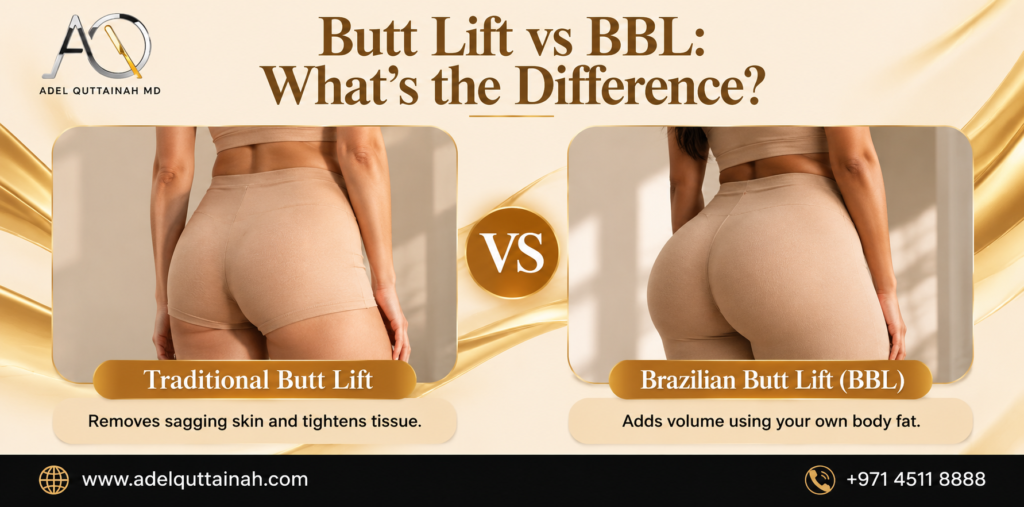
A traditional butt lift (surgical mastopexy or gluteal lift) removes loose, sagging skin and tightens the surrounding tissues without altering volume, whereas a Brazilian butt lift vs butt lift comparison highlights that a BBL transfers fat from other body areas to increase gluteal fullness.
Understanding the core structural focus of each procedure helps clarify butt lift vs BBL:
- Traditional butt lift: Focuses purely on excision and tightening. Dr Adel Quttainah removes excess, redundant skin along the lower back or upper gluteal crease to smooth out severe sagging caused by significant weight loss or natural ageing. Patients with loose skin on the inner thighs may also consider a Thigh Lift.
- Brazilian butt lift (BBL): Focuses on volumetric enhancement and strategic reshaping. The procedure involves harvesting donor fat via liposuction from areas such as the abdomen, flanks, or thighs, purifying it, and reinjecting it into specific gluteal layers to create a rounder, fuller profile.
Comparing Butt Lift vs Brazilian Butt Lift: At a glance

Evaluating butt lift vs Brazilian butt lift side by side highlights how surgical goals, candidates, and techniques differ.
Surgical aspect | Traditional Butt Lift | Brazilian Butt Lift (BBL) |
Primary surgical objective | Removes loose skin and tightens sagging tissue. | Adds volume, projection, and reshapes contour using autologous fat transfer. |
Volume change | No volume added; may slightly reduce size due to tissue removal. | Increases gluteal volume and enhances roundness. |
Primary incisions & scars | Surgical incisions placed along the upper buttocks/lower back crease to excise skin. | Tiny cannula puncture incisions placed at liposuction donor sites and injection points. |
Requirement for fat | Does not require donor body fat. | Requires adequate fat deposits elsewhere on the body for harvesting. |
Tissue laxity addressed | Highly effective for severe skin redundancy and laxity. | Best suited for patients with good skin elasticity. |
Who is a good candidate for a Butt Lift?

A good candidate for a traditional butt lift is an individual with significant skin redundancy, poor tissue elasticity, and sagging who does not seek additional gluteal volume. Dr Adel Quttainah typically recommends a traditional excisional butt lift for patients who meet the following clinical criteria:
- Post-bariatric or significant weight loss: Patients who have lost substantial weight and are left with drooping skin around the lower torso and buttocks. Some patients also pair the procedure with a Tummy Tuck to address the abdomen.
- Good general health: Individuals maintaining a stable weight with no uncontrolled medical conditions that could impair wound healing.
- Realistic expectations regarding scarring: Patients who understand that removing significant amounts of skin involves longer surgical incisions that fade over time.
Who is a good candidate for a BBL?
A good candidate for a BBL is a patient seeking increased gluteal fullness and improved body proportion who has adequate donor fat available for transfer. When evaluating patients for fat grafting, Dr Adel Quttainah looks for key anatomical indicators:
- Sufficient donor fat deposits: Candidates must possess localised fat in donor regions such as the abdomen, waist, back, or thighs to harvest enough viable cells.
- Adequate skin tone: Firm, elastic skin capable of adapting naturally to new underlying volume without sagging.
- Lifestyle commitment: Willingness to follow strict post-operative sitting restrictions (avoiding direct pressure on the buttocks for several weeks) to preserve transferred fat survival.
What is the expected recovery timeline after surgery?

Recovery varies based on the specific procedure performed, with surgical incision care being primary for a traditional lift and pressure restriction being critical for a BBL. For a combined procedure, see the Mommy Makeover Recovery Timeline to know what to expect.
Traditional Butt Lift recovery
- Weeks 1–2: Localised discomfort, swelling and tightness around the site of excision. Light walking is encouraged to promote circulation.
- Weeks 3–6: Gradual return to non-strenuous daily activities while wearing prescribed support garments to reduce tension on incision lines.
- Months 3–6: Complete scar maturation and final tightening results become fully apparent.
BBL recovery
- Weeks 1–3: Patients should not sit or lie on their backs directly on the grafted fat to ensure viability of the grafted fat. To control swelling after liposuction, a special compression garment is worn.
- Weeks 4–6: Light sitting with a specialised BBL pillow is re-introduced; light physical activity can usually resume.
- Months 3–6: Swelling fully resolves, and injected fat cells establish a permanent blood supply, settling into their final position.
What are the clinical risks associated with these surgeries?
As with any major surgical procedure, both options carry clinical risks that require careful pre-operative discussion and adherence to post-operative guidelines. Potential risks include:
- Common surgical side effects like infection, bleeding, seroma (Fluid under the skin) or delayed wound healing.
- For traditional butt lift: Scar widening, asymmetry, or localised skin numbness around surgical excision sites.
- For BBL: Partial fat reabsorption (transferred fat partially does not survive), asymmetry or fat necrosis. Fat grafting requires strict adherence to anatomical placement protocols in subcutaneous layers to ensure patient safety.

How Long Do Plastic Surgery Results Last?
How Long Do Plastic Surgery Results Last? A Guide to Long-Lasting Results Plastic surgery can

Butt Lift vs BBL: What’s the difference?
Butt Lift vs BBL: What’s the difference? A Surgeon’s Guide to Choosing Between the Two

Breast Lift Without Implants: Who Is It Best For?
Breast Lift Without Implants: Who Is It Best For? Insights from a Board-Certified Plastic Surgeon
Ready to take the next step toward your ideal contour?
Understanding whether a butt lift, a BBL, or a combination procedure is right for you requires an expert, individualised assessment. Schedule a comprehensive consultation with Dr Adel Quttainah today to discuss your aesthetic goals, explore your options, and receive a bespoke treatment plan designed around your body.Are you considering facial rejuvenation? The deep plane facelift is known as one of the most advanced and long-lasting options today. It restores youthful contours by working on deeper facial layers, giving you natural results that can last 10 to 15 years or longer.
Dr. Adel Quttainah uses both skill and an artistic approach to achieve results that look refreshed, not overdone. From your first consultation to your recovery, Dr. Quttainah will support you at every stage, making sure your goals are clear, your expectations are realistic, and your results suit you.
FAQs
No, a traditional butt lift removes excess sagging skin to tighten the lower body, whereas a BBL uses fat transfer (liposuction and reinjection) to increase gluteal volume and reshape contour.
Both procedures have their advantages, but which is the best one for you depends on your anatomical requirements. The traditional lift works better for patients who have a lot of skin that needs to be lifted, and BBL works better for patients who are looking for increased volume and shape.
No, a traditional excisional butt lift will not add volume, and it can sometimes make the size smaller by removing excess skin. Just tightening the tissue, however, will make it firmer and higher.
No, a traditional excisional butt lift will not add volume, and it can sometimes make the size smaller by removing excess skin. Just tightening the tissue, however, will make it firmer and higher.
A traditional skin-excision butt lift cannot add volume. To increase size, fat transfer (BBL) or gluteal implants must be incorporated.
A buttock lift removes loose skin to correct drooping, while buttock augmentation adds size and volume through autologous fat transfer (BBL) or implants.
Yes, in selected cases where a patient experiences both severe skin laxity and volume loss, Dr Adel Quttainah can design a combined procedure that excises loose skin while selectively grafting fat to restore youthful projection.
About the author

Dr. Adel Quttainah
- Board-Certified Plastic & Reconstructive Surgeon
- Founder of Quttainah Medical Center (QMC)
- 20+ Years of Private Clinical and Surgical Experience
- International Facial Plastic & Body Contouring Expert
Dr. Adel Quttanah is an exceptionally qualified Western-trained plastic and reconstructive surgeon specializing in complex facial rejuvenation, advanced breast aesthetics and whole body contouring procedures. After graduating from specialized surgical training at leading medical centers in Canada, he moved his broad clinical knowledge to the patients in the Middle East.
Dr. Adel Quttanah is a leading expert in advanced cosmetic and reconstructive surgery and is known for his structural, anatomic approach to the face. He was one of the first in the area to create total integrated aesthetic setups that maintain absolute facial harmony while delivering long-term, natural, and beautiful looks to more complex facial rejuvenation treatments like deep plane facelifts.
Medical Disclaimer
This article is for informational purposes only and is not a substitute for professional medical advice, diagnosis, or treatment. Always seek the advice of a qualified health provider with any questions you may have regarding a medical condition. Medically reviewed by Dr. Adel Quttainah