
Deep Plane Facelift vs SMAS Facelift: What’s the Difference?
Expert Insights from a Plastic Surgeon
Facelift surgery has evolved significantly over the years, moving away from overly tight and unnatural results towards more refined, anatomical facial rejuvenation.
Today, one of the most commonly discussed comparisons is deep plane facelift vs SMAS facelift, as patients increasingly seek natural-looking and long-lasting outcomes.
While both procedures are designed to address visible signs of facial ageing, they differ in surgical depth, tissue handling, recovery, and overall rejuvenation approach.
At the practice of Dr. Adel Quttainah, patients are often guided through the differences between what is Deep Plane Facelift vs SMAS Facelift surgery is to help determine the most suitable technique for their facial anatomy and aesthetic goals.
A quick understanding before comparing the proceduresInstead of viewing facelift surgery as a single operation, it is more accurate to think of it as a category of procedures designed to address different layers of facial ageing. Some techniques primarily tighten the skin, while others reposition the deeper structural support system of the face. Modern facelift surgery generally focuses on three key goals:
The deeper the surgical correction, the more comprehensive the rejuvenation tends to be. |
What happens to the face during the ageing process?
Facial ageing is a structural process involving multiple tissue layers, not just loose skin.
From the late 30s onwards, the face gradually undergoes:
- Loss of collagen and elastin
- Weakening of facial retaining ligaments
- Descent of cheek fat pads
- Bone resorption around the jaw and eye area
- Skin thinning and reduced elasticity
- Development of jowls and neck laxity
One of the most important anatomical structures involved in this process is the SMAS layer, or superficial musculoaponeurotic system.
This fibromuscular layer lies beneath the skin and helps support facial tissues. As the SMAS weakens and descends, the cheeks flatten, folds deepen, and jawline definition gradually softens.
Modern facelift surgery works to reposition this deeper support system rather than simply pulling the skin tighter.
Different types of facelift surgery
Before discussing deep plane facelift vs SMAS facelift, it is important to understand the broader spectrum of facelift techniques used today.
Traditional skin-only facelift
This older approach was primarily about pulling loose skin tighter, without giving much attention to the deeper facial structures. It offered some improvement in skin laxity, but the results often looked a little too tight or unnatural and were not known for lasting very long.
Mini facelift
A mini facelift is less invasive and usually recommended for younger patients with early signs of ageing. If you’re wondering what does a mini facelift do, it primarily addresses mild jowling and lower-face laxity by tightening and lifting the underlying tissues. The procedure involves smaller incisions, less extensive correction, and a shorter recovery period compared to a traditional facelift.
SMAS facelift
This technique addresses the deeper SMAS layer beneath the skin, creating more natural and longer-lasting improvement compared to skin-only facelifts.
Deep plane facelift
A deep plane facelift works underneath the SMAS layer, releasing the retaining ligaments to reposition the deeper facial tissues in a far more thorough way.
Vertical facelift
This approach focuses on lifting tissues upward rather than pulling them to the side, which helps recreate the natural youthful contours of the face more effectively.
Composite facelift
A composite facelift is a bit of an all-rounder, combining deep tissue repositioning with eyelid and midface rejuvenation to address a broader range of concerns and deliver more complete correction.
Neck lift
Although technically separate, neck lift are commonly combined with facelift surgery to improve neck bands, excess skin, and jawline contour.
Did You Know?The term “deep plane” refers to the anatomical surgical layer beneath the SMAS, where surgeons can release facial ligaments and mobilise the cheeks more naturally as a single structural unit. |
What is SMAS facelift surgery?
The SMAS facelift represented a major advancement in facial rejuvenation because it addressed the deeper structural layer responsible for facial support.
Instead of pulling the skin tightly, the surgeon lifts and repositions the SMAS layer itself, creating more natural contour restoration.
How Is an SMAS Facelift performed?
During surgery:
- Incisions are carefully hidden around the ears and hairline
- The skin is elevated conservatively
- The SMAS layer is tightened, folded, or repositioned
- Excess skin is removed without excessive tension
- Jawline and neck contours are refined
Because the structural layer is corrected directly, the results often appear softer and more anatomically balanced.
What concerns does SMAS facelift surgery address?
An SMAS facelift may improve:
- Early jowl formation
- Mild to moderate facial sagging
- Neck laxity
- Jawline softening
- Lower-face heaviness
- Moderate skin looseness
This technique is still a strong choice for patients who are after noticeable rejuvenation but would rather avoid the more extensive dissection that comes with deeper facelift procedures.
What is Deep Plane Facelift surgery?
Understanding what is deep plane facelift surgery requires looking beyond the superficial layers of the face.
A deep plane facelift extends beneath the SMAS layer and releases facial retaining ligaments that anchor descended tissues downward. Once these deeper attachments are released, the surgeon can reposition the cheeks, midface, jawline, and lower face as a unified anatomical structure.
This allows more comprehensive correction of advanced facial ageing.
Why is the Deep Plane Technique considered advanced?
Unlike more superficial facelift methods, the deep plane approach:
- Mobilises deeper facial tissues
- Reduces tension placed on the skin
- Restores cheek position more effectively
- Softens deep nasolabial folds
- Preserves natural facial animation
Because the tissues move together naturally, the results often appear less “operated” and more harmonious.
However, this procedure is technically demanding and requires advanced anatomical expertise.
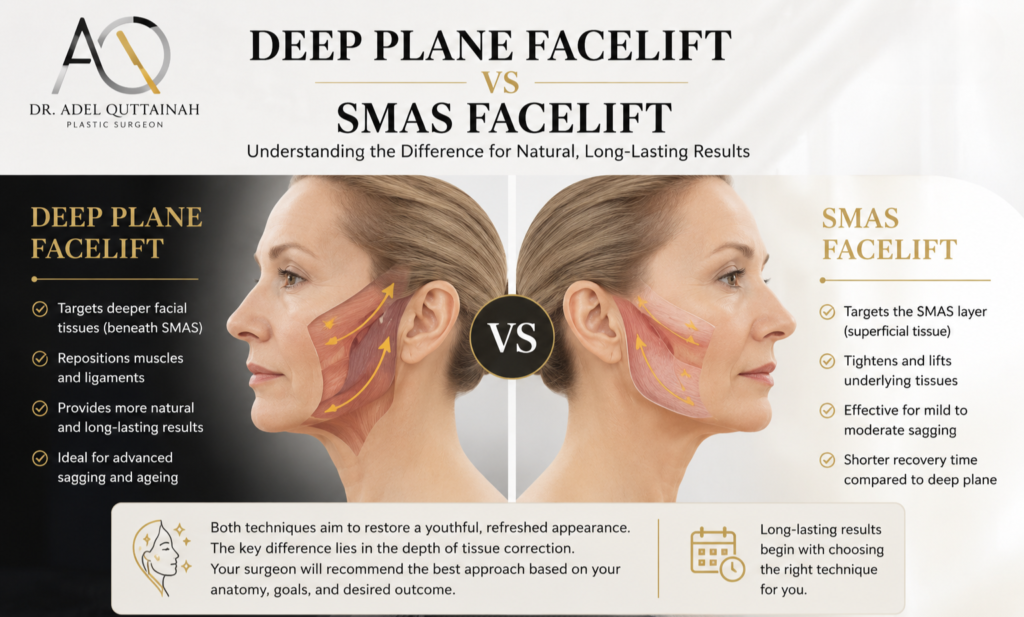
Deep Plane Facelift vs SMAS Facelift: What is the main difference?
The fundamental difference between deep plane facelift vs SMAS facelift lies in the depth of dissection and how the facial structures are repositioned.
SMAS Facelift
In an SMAS facelift, the surgeon works primarily on the superficial muscular layer beneath the skin. The SMAS is tightened and repositioned, but many retaining ligaments remain intact.
Deep Plane Facelift
A key part of the deep plane facelift involves fully releasing the retaining ligaments, which allows the midface and cheeks to be lifted in a far more extensive way.
This deeper correction often provides:
- Better cheek elevation
- More comprehensive facial rejuvenation
- Softer transitions around the mouth
- Reduced skin tension
- Longer-lasting support
Both techniques can produce great results, but when it comes to how deep the correction goes anatomically, there is quite a notable difference between the two.
How do the results compare between the procedures?
One of the most searched concerns regarding deep plane facelift vs SMAS facelift results is whether one procedure creates more natural rejuvenation.
The answer depends largely on the patient’s anatomy and degree of ageing.
SMAS facelift Results Often Include:
| Deep Plane Facelift Results Often Include:
|
Patients with advanced facial descent may notice more dramatic structural improvement with deep plane surgery.
Which facelift technique lasts longer?
Another major point in the discussion around deep plane facelift last vs SMAS facelift recovery and longevity is durability.
Procedure | Average longevity |
Mini Facelift | 3–5 years |
SMAS Facelift | 7–10 years |
Deep Plane Facelift | 10–15 years |
Several factors influence how long results last:
- Skin quality
- Genetics
- Smoking
- Sun exposure
- Weight stability
- Lifestyle habits
No facelift permanently stops ageing, but modern structural techniques generally age more naturally over time.
What is recovery like after surgery?
Recovery varies between individuals, but both procedures require patience and proper aftercare.
Common recovery experiences
Patients may experience:
- Swelling
- Bruising
- Tightness
- Mild numbness
- Temporary sensation changes
Recovery timeline comparison
Recovery stage | SMAS facelift | Deep Plane facelift |
Swelling and bruising | 1–2 weeks | 2–3 weeks |
Return to social activities | Around 2 weeks | Around 3 weeks |
Return to exercise | 3–4 weeks | 4–6 weeks |
Final refined results | 2–3 months | 3–6 months |
Most patients describe discomfort as manageable rather than severely painful.
Which patients are better candidates for each procedure?
At Dr. Adel Quttainah, facelift recommendations are based on detailed facial analysis rather than trends alone.
SMAS facelift candidatesThis technique may suit patients with:
| Deep plane facelift candidatesThis procedure may suit patients with:
|
The “best facelift technique” is always the one tailored to the patient’s anatomy and long-term goals.

Breast Lift Without Implants: Who Is It Best For?
Breast Lift Without Implants: Who Is It Best For? Insights from a Board-Certified Plastic Surgeon

7 Questions to Ask Before Choosing a Plastic Surgeon
7 Questions to Ask Before Choosing a Plastic Surgeon Expert Insights from a Plastic Surgeon

Open vs Closed Rhinoplasty: Which Technique Is Right for You?
Open vs Closed Rhinoplasty: Which Technique Is Right for You? Expert Insights from a Plastic
Choosing the right facelift technique
The growing discussion around deep plane facelift vs SMAS facelift reflects how modern facial rejuvenation has moved towards more natural, anatomy-based results rather than overly tightened appearances. Both procedures can deliver long-lasting and refined outcomes when tailored correctly to the patient’s facial structure and ageing pattern.
SMAS facelift surgery tends to do a great job with moderate signs of ageing, but for those with deeper facial sagging and midface descent, a deep plane facelift could well offer more comprehensive rejuvenation overall.
At the practice of Dr. Adel Quttainah, the focus remains on creating balanced, natural-looking results that preserve facial expression and individuality rather than changing how a person looks.
FAQ's
Is deep plane facelift better than SMAS facelift?
Not necessarily. The right procedure depends on the patient’s facial anatomy, degree of ageing, and aesthetic goals. For deeper facial sagging, a deep plane facelift may offer more extensive rejuvenation, whilst a SMAS facelift can work really well for more moderate signs of ageing.
Which facelift lasts longer?
In general, deep plane facelift results tend to last longer because the deeper facial structures and retaining ligaments are repositioned more comprehensively. It is worth noting that lifestyle, skin quality, and how a person ages naturally can all have a significant impact on how long the results hold up.
Is deep plane facelift more natural?
Many patients feel that deep plane facelift surgery creates softer and more natural-looking results because the deeper tissues are lifted together instead of placing tension mainly on the skin. The face often looks refreshed rather than “tight.”
What is the downside of deep plane facelift?
A deep plane facelift is a more advanced procedure and usually involves slightly longer swelling and recovery. Because the surgery works closer to deeper facial structures, choosing an experienced facial plastic surgeon is especially important.
Is SMAS facelift worth it?
Yes, SMAS facelift surgery remains one of the most trusted and widely performed facelift techniques worldwide. It can provide noticeable improvement in jawline definition, facial laxity, and lower-face ageing while still maintaining natural facial expression.
Which facelift gives the best jawline?
Both procedures can improve jawline contour, but patients with heavier jowls or more advanced sagging may notice stronger definition with a deep plane facelift. The final outcome also depends on skin quality and neck anatomy.
What age is best for deep plane facelift?
There is no “perfect” age for facelift surgery. Many patients consider a deep plane facelift in their late 40s to 60s, but the decision is usually based more on facial ageing patterns than age alone.
How long does recovery take?
Most patients feel comfortable returning to social activities within two to three weeks, although mild swelling can continue improving for several months. Recovery timelines vary depending on the extent of surgery and individual healing.
Is deep plane facelift safer?
Both SMAS facelift and deep plane facelift surgery are generally safe when performed by an experienced surgeon. The most important factor is proper surgical expertise, careful planning, and selecting the right technique for the patient.
About the author

Dr. Adel Quttainah
- Board-Certified Plastic & Reconstructive Surgeon
- Founder of Quttainah Medical Center (QMC)
- 20+ Years of Private Clinical and Surgical Experience
- International Facial Plastic & Body Contouring Expert
Dr. Adel Quttanah is an exceptionally qualified Western-trained plastic and reconstructive surgeon specializing in complex facial rejuvenation, advanced breast aesthetics and whole body contouring procedures. After graduating from specialized surgical training at leading medical centers in Canada, he moved his broad clinical knowledge to the patients in the Middle East.
Dr. Adel Quttanah is a leading expert in advanced cosmetic and reconstructive surgery and is known for his structural, anatomic approach to the face. He was one of the first in the area to create total integrated aesthetic setups that maintain absolute facial harmony while delivering long-term, natural, and beautiful looks to more complex facial rejuvenation treatments like deep plane facelifts.
Medical Disclaimer
This article is for informational purposes only and is not a substitute for professional medical advice, diagnosis, or treatment. Always seek the advice of a qualified health provider with any questions you may have regarding a medical condition. Medically reviewed by Dr. Adel Quttainah